
Nicholas Hodges: Corruption, Terror, and the Manufactured Fugitive in Simpson County
From the Chop Block Table Top


MENDENHALL, MS — When a local sheriff’s department begins a frantic public relations campaign to frame a local citizen as a “dangerous felon on the loose,” it is rarely about public safety. More often than not, it is about a desperate county administration scrambling to throw up a smokescreen before the klieg lights of an impending media exposé reveal the absolute rot eating away at their foundation.
Right now, that manufactured smokescreen is drifting over Simpson County, Mississippi. At its center is Nicholas Hodges, a man who, until this morning, was the target of a massive, multi-jurisdictional manhunt across county lines. His crime? Turning himself in with the help of his mother after fleeing for his life from an officer whom the public genuinely believes is a psychopath in a uniform.
The officer who initiated the terror is Deputy Jason Runnels. To understand why Nicholas Hodges ran, why he showed up at his grandmother’s house terrified out of his mind, crying that the police were going to kill him, you must look past the press releases issued by Sheriff Paul Mullins. You must look at the bodies left in Deputy Runnels’ wake. You must look at a department that protects a man who has allegedly killed two people, crippled two others, and beaten another citizen within an inch of his life.
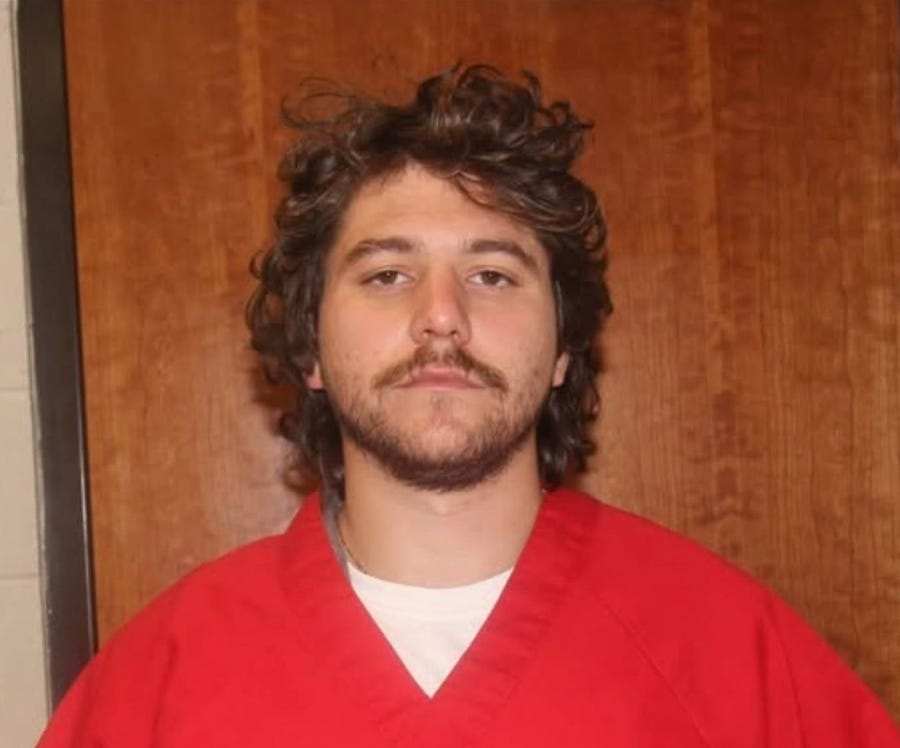
This is an investigative breakdown of the hunting of Nicholas Hodges, the systemic Brady liabilities haunting the Simpson County Sheriff’s Department, the legal statutes governing this abuse of power, and the desperate tactical diversion being played by an administration cornered by its own corruption.
The sequence of events that led to a multi-agency dragnet began not with a violent felony, but with a scene of absolute normalcy. According to corroborated accounts from multiple eyewitnesses, Nicholas Hodges was sitting down by the river playing his guitar, playing music for people, and goofing off.
While there, Hodges noticed a construction hard hat that had been left behind at a job site by workers. In a moment of harmless eccentricity, he walked over, picked it up, put it on his head, and went back to playing his guitar with the hard hat on. It was a completely victimless, benign action.
However, a local caller—described by an eyewitness as a “busybody”—dialed 911. The caller falsely reported to dispatch that a man was actively “robbing the construction site.”
Enter Deputy Jason Runnels. Runnels responded to the scene in full uniform, operating alone. Eyewitnesses describe Runnels arriving aggressively, walking fast, and immediately escalating the situation. Without executing a proper, lawful investigation or asking a single baseline question, Runnels closed the distance, barking, “Hey, you come here.”
Before Hodges could understand what was happening, Runnels grabbed him, spun him around, and began aggressively digging directly into his pockets.
“Man, what are you doing?” Hodges asked, startled and defenseless.
Runnels’ response was immediate hostility: “I said fucking turn around.”
As Runnels grabbed him again, panic set in. This was not a standard, professional police interaction; it was an aggressive, physical assault by an officer known throughout the region for a terrifying, explosive temper. In a desperate bid to preserve his own safety, Hodges pulled away and ran. In the confusion of the sudden physical encounter, Hodges accidentally bumped into Runnels. He did not strike the officer. He did not swing. He did not attack. He merely made physical contact as he fled from a terrifying situation.
Four separate eyewitnesses—including two independent bystanders, Hodges’ mother, and Hodges himself—corroborate this exact sequence of events. There was no assault on law enforcement.
But Deputy Runnels knew what he wanted the narrative to be. He immediately keyed his radio and called in a false emergency: an active “assault on an officer.”
The moment that radio transmission went live, the machinery of state violence spun into motion. Because the incident occurred right on the Rankin County line, dispatchers scrambled units from multiple jurisdictions. Suddenly, two separate sheriff’s departments were hunting Nicholas Hodges down through the woods and neighborhoods as if he were a mass murderer.
Terrified and fleeing for his life, Hodges made it to his grandmother’s house. Witnesses recall him bursting through the door, trembling and weeping, screaming, “They’re gonna fucking kill me, Grandma!”
He was right to be terrified. He knew exactly who was behind the badge.
Does Simpson County Have a Psychopath on the Force?
To answer the question of whether Deputy Jason Runnels exhibits psychopathic, predatory behavioral patterns under color of law, one only needs to look at his operational history in the region. The public does not fear Runnels because of standard police authority; they fear him because interaction with him has repeatedly proven to be a death sentence or a fast track to the intensive care unit.
Runnels’ career is punctuated by extreme, unchecked physical violence. Runnels has already caused the deaths of two individuals while operating in a law enforcement capacity—Brandon Cross Duval and Jared Padgett. In any standard, functional police department, a single officer-involved fatality triggers exhaustive internal review and psychological profiling. To have two deaths attached to one deputy’s record is an astronomical red flag that screams “deliberate indifference” by management.
Runnels allegedly beat a local citizen, Terry Bynum, so severely that Bynum was left hovering near death. The injuries inflicted were not the result of standardized compliance techniques; they were the hallmarks of an unrestrained, brutal assault.
Two other men suffered permanent, significant physical harm and ongoing trauma directly at the hands of Runnels during past encounters.
When an officer establishes a multi-year track record of killing citizens, crippling suspects, and beating defenseless men almost to death, his presence on the street is no longer a failure of training—it is an active threat to the public. Nicholas Hodges knew this track record. When Hodges felt Runnels’ hands violently tearing into his pockets over a plastic construction hat, he didn’t see an officer conducting a temporary investigation; he saw a man who might beat or shoot him to death and write a falsified report to cover it up. His flight was an act of pure, survival-driven self-preservation.
How do you safely interact with this rogue deputy?
In a perfect world, a citizen complies with law enforcement, handles discrepancies in a courtroom, and stays safe. But in a jurisdiction like Simpson County, where rogue deputies are insulated by administrative protection, standard compliance advice can get a person killed. If a citizen finds themselves facing an aggressive, unhinged interaction with an officer like Runnels, specific survival protocols must be deployed:
1. Strict Verbal Non-Resistance with Max Visibility: Keep hands open, flat, and above the waist at all times. Do not make sudden movements, even to reach for an ID, without explicitly stating your intent first (e.g., “I am reaching for my wallet in my back-left pocket now”).
2. The Power of Third-Party Recording: If you are a bystander or a passenger, film the interaction immediately. Stream live if possible. Officers with predatory tendencies are acutely aware of the digital gaze. A camera is often the only shield that prevents a physical escalation.
3. Surrender Through Counsel or Intermediaries: If an incident escalates and an officer fabricates a charge—as Runnels did by radioing a false assault claim—do not attempt to hide indefinitely. The safest resolution is the exact path Nicholas Hodges took: vanish to a safe location, contact family, secure legal counsel, and coordinate a controlled surrender directly at a centralized facility or jail, preferably with an attorney or credible witnesses present to document your uninjured physical state upon booking.
The actions of Deputy Runnels and the subsequent escalation by the Simpson County Sheriff’s Department violate established federal constitutional doctrines and Mississippi state statutes. When this matter enters a federal court, the litigation will pivot around several key legal pillars.
Deputy Runnels responded to a generic 911 call about a man wearing a construction hat. Under established Fourth Amendment law, a vague, non-violent tip does not give an officer immediate license to conduct a highly intrusive physical search. Runnels did not possess reasonable suspicion that Hodges was armed and dangerous; therefore, reaching directly into Hodges’ pockets was an unconstitutional, unlawful search from its inception.
Under Brady, the prosecution is legally required to hand over any exculpatory or impeachment evidence regarding the state’s witnesses to the defense. Because Runnels is the complaining witness against Hodges, his entire history—the deaths of Brandon Cross Duval and Jared Padgett, the near-fatal beating of Terry Bynum, and his internal affairs disciplinary file—becomes mandatory Brady disclosure material. A court will force the county to open these files, exposing the department’s darkest secrets.
To sue Sheriff Paul Mullins and Simpson County civilly, a plaintiff must prove that a departmental “policy, custom, or practice” caused the constitutional violation. By keeping Runnels on the force after two deaths and multiple severe beatings, Sheriff Mullins has established a custom of “deliberate indifference” to officer brutality, opening the county to massive civil rights liability.
Miss. Code Ann. § 97-3-7(1)(b) (Simple Assault on a Law Enforcement Officer) is the felony charge the sheriff’s department is attempting to fabricate against Hodges. However, the statute explicitly requires the state to prove that the defendant purposely, knowingly, or recklessly caused bodily injury to the officer. Because four eyewitnesses can confirm that Hodges merely bumped into Runnels while fleeing in terror and caused absolutely zero injury, the state cannot meet the statutory definitions required for a conviction.
Per Miss. Code Ann. § 97-9-73 (Resisting Arrest), the state will argue that Hodges resisted a lawful arrest. The defense, however, can counter that because Runnels’ initial physical search was entirely unconstitutional and unauthorized, the subsequent attempt to detain him was an unlawful arrest, which invalidates the core structural element of the statute.
Miss. Code Ann. § 97-35-47 (False Report of a Crime) applies directly to the busybody citizen who called 911 to report a “robbery” because a man was playing a guitar with a discarded hard hat on his head.
Why has the Simpson County Sheriff’s Department gone to such extreme lengths to blow this specific incident out of proportion? Why did Sheriff Paul Mullins deploy multiple jurisdictions to hunt down a guitar player over an accidental, non-injurious physical bump?
The answer is simple: Fear of Exposure.
Sheriff Paul Mullins is fully aware that a massive, multi-part investigative television exposé is currently being finalized and about to be broadcast by a prominent local TV station. This upcoming investigative report focuses on a trio of deputies whose deeply compromised histories threaten to bring down Mullins’ entire administration.
The violent liability of Runnels, whose history of killing Brandon Cross Duvall and Jared Padgett, and beating Terry Bynum, is finally coming to light on mainstream television.
Deputy Michael Payne is an insider and former “Top Cop” whose personnel file contains explosive liabilities. Our sources have confirmed that Payne is facing severe allegations of official misconduct for utilizing text messages to send graphic photos of active, ongoing death investigation scenes—featuring deceased individuals—to a personal love interest. This grotesque violation of evidence integrity and privacy rights compromises every single homicide file Payne has ever touched.
Deputy Marvin Miller, the veteran deputy, whose alleged conduct under color of law is predatory. Miller is facing a barrage of structural allegations that he actively coordinated and engaged in sexual encounters with civilian women inside his official, county-issued squad car in direct exchange for lowering or dismissing traffic citations.
This trifecta of institutional corruption—unrestrained violence (Runnels), severe evidence tampering/perversion (Payne), and sexual extortion under color of law (Miller)—renders the entire Simpson County Sheriff’s Department an absolute legal hazard.
Sheriff Paul Mullins knows that the moment this broadcast airs, his political career is effectively finished, and the county will be inundated with federal civil rights lawsuits. To get ahead of the story, Mullins has deliberately shifted the public message. By transforming Nicholas Hodges’ terrifying flight into a theatrical, high-stakes hunt for a “dangerous felon,” Mullins is attempting to control the narrative. He wants the public to view Deputy Runnels as a brave, victimized law enforcement officer who was “assaulted” in the line of duty, rather than a volatile, unchecked liability with a history of violence. It is a textbook, desperate public relations pivot designed to frame the upcoming TV exposé as an unfair “anti-police attack” rather than what it is: a necessary extraction of systemic rot.
The hunting of Nicholas Hodges was never about justice, and it was never about a stolen construction hat. It was the frantic, panicked thrashing of a cornered sheriff’s department trying to shield its most violent actors from the light of day. By turning himself in safely this morning with his mother’s assistance, Hodges took the weapon of a manufactured narrative out of Sheriff Mullins’ hands.
Now, the battle shifts from the woods of the Rankin County line to the courtrooms of Mississippi. When Hodges’ defense counsel demands the Brady packets for Runnels, Payne, and Miller, the county will be forced to choose between drop-kicking a fabricated assault charge or exposing the systematic extortion, evidence leaks, and officer-involved killings that they have spent years trying to bury.
Sheriff Mullins tried to build a smokescreen. Instead, he has only succeeded in drawing the spotlight exactly where it belongs: on the systemic lawlessness operating under the badge in Simpson County.
Sources:
Photographic Artifact & Audio Transcript File: “image_9628a6.png” (Detailed multi-witness dictation log outlining the river encounter, Deputy Runnels’ pocket search, the false radio transmission, the multi-jurisdictional dragnet, and references to regional structural corruption/Simpson County CI interference).
Confidential Investigative Files: Detailed accounts of officer-involved fatalities, specifically tracking the deaths of Brandon Cross Duvall and Jared Padgett under the operational custody/action of Deputy Jason Runnels.
Medical & Incident History Records: Case file details concerning the severe physical trauma and near-fatal beating of civilian Terry Bynum, alongside ongoing physical injury documentation for two additional unnamed male victims.
Internal Departmental Communications: Corroborated text message logs and digital metadata indicating Deputy Michael Payne transmitted active, confidential investigative scene photos of deceased individuals to a third-party personal contact.
Affidavits and Witness Statements: Transcribed field statements alleging a pattern of sexual misconduct and traffic ticket quid-pro-quo exploitation by Deputy Marvin Miller utilizing county-issued vehicles.
Federal Case Law Precedents: Brady v. Maryland, 373 U.S. 83 (1963); Monell v. Department of Social Services, 436 U.S. 658 (1978); Terry v. Ohio, 392 U.S. 1 (1968).
Mississippi Statutory Code: Miss. Code Ann. § 97-3-7 (Simple/Aggravated Assault framework); Miss. Code Ann. § 97-9-73 (Resisting Arrest framework); Miss. Code Ann. § 97-35-47 (False Reporting framework).
 | A guest post by
|